

Fishpole Lake
How Flin Flon got its name

I wrote last week about the threat of destruction by fire of Flin Flon, my hometown. It now appears the town will be spared, even as the surrounding forest continues to burn. As origin stories go, Flin Flon has a strange one. There’s even a presentiment in the novel that gave the town its name.
“As the adventurous voyager stood there, gazing upon all this mystery and weirdness, he pictured the time when birds sang in the branches of the now stony trees, when balmy breezes rustled their leaves into pleasant music, and thousands of bright glad insects hummed their praises among the waving grasses and the nodding flowers. Flin Flon knew that all these things must have been in far-off ages, until some incomprehensible convulsion of nature turned this part of the world upside down and buried forever out of sight this glorious forest.”
– J.E. Preston Muddock, The Sunless City, 1905
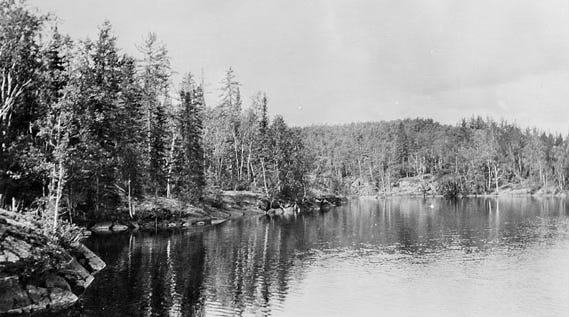
It was one lake among hundreds of thousands that bless the Canadian landscape. Crowding down to its rocky shore, spruce and pine mixed with birch and aspen, tamarack and fir. Its waters were filled with pickerel and suckers, northern pike and perch, the usual menu. Frogs and ducks and leeches called it home. Beavers built their scrappy hideaways. Loons and cormorants paddled its waters in summer and an occasional pelican might drop by. Eagles and ravens patrolled above, sometimes tangling in mid-air because these birds did not like each other. Bears, wolves, foxes, lynx, martens, and other fur-bearing animals knew the lake, and yes, there were insects, buzzing all summer long, competing to eat and escape being eaten.
It was an inconsiderable body of water compared with nearby Amisk and Athapapuskow, where from mid-lake the shoreline is a thin black line that disappears altogether in morning mists and snow squalls. Indigenous hunters and trappers snow-shoed or paddled the lake, had camped on its shores for thousands of years. Near its east shore was a quarry where they chipped scrapers and spear points. Transliterated from Cree, they called the lake Fishpole, perhaps referring to the gaffing stick used in springtime to haul the bounty from creeks that ran into its depths. Then white men came and gave the lake a new name, sacrificing it to their restless need to conquer and prosper.
What happened on the shore of Fishpole Lake is documented, but the man for whom it was renamed is a preposterous fiction. Josiah Flintabbaty Flonatin was conceived in the overheated brain of J.E. (Joyce Emmerson) Preston Muddock, a writer whose own handle was mouthful enough that it he took a penname from his most successful fictional creation, a detective he called Dick Donovan. Muddock was an Englishman, a Victorian more energetic than eminent, who lived long and riotously. Among many exploits, he claimed to have been caught up in the 1857 Indian Rebellion, panned for gold in Australia, and, he said, dined with cannibals in the South Pacific.
Prolific hardly begins to describe his literary output. He wrote forty-two novels and short story collections as Dick Donovan, and thirty some novels more as Muddock – science fiction, historical fiction and horror stories. Toss in a few non-fiction books and journalism.
In 1905, Muddock, using his own name, turned out The Sunless City, a truly awful book. Its hero, Flintabbaty Flonatin, is a bankrupt storekeeper who builds a one-man submarine in the shape of a fish, which he pilots into the depths of Lake Avernus, so deep it is reputed to be bottomless. Flintabbaty descends overnight to a depth of 1,500 fathoms, and, upon awakening, breakfasts “right royally on a bottle of superb claret, some hard-boiled eggs, which had been prepared the day before, a few delicate slices of delicious ham, and finished off with a choice cut from a magnificent boar's head stuffed with truffles.”
An underwater current carries his sub to a land whose inhabitants have tails and live for hundreds of years. They speak English but write the language backwards. The streets are paved with gold, which is considered valueless – tin is used as currency. Most disconcerting for Flin, the women he meets are robust and have beards. They rule over soft, unmanly men. Frightened by this, the hero escapes back to the earth’s surface by climbing the magma chamber of an extinct volcano. Sigmund Freud, whose career was taking shape about the same time, would have had a field day with Muddock.
Despite the extravagant plot and florid detailing, Muddock’s book is almost unreadable. Its fate, like most of his output, was to be dropped into the Avernus of bad books, there to be forgotten.
Except, someone always finds a forgotten a book. In this case, he was a prospector in the company of four or five others who in 1913 were paddling the lakes and streams of the Churchill River system in northern Saskatchewan. When the prospectors stopped for lunch on a portage, one of them noticed what looked like a tattered book half hidden under a fallen tree. It was The Sunless City.
Fresh reading material being in short supply in the bush, the men kept and read the book. Despite its shortcomings, they were drawn to its descriptions of gold in abundance. It was the very thing they were looking for. The bigger problem for them was that the final few pages had been torn away. How did it end? Speculation was that the missing pages had been used to light a fire, or, as likely, were required to assist in a bodily function that might also have been taken as critical comment by the book’s last reader.
The prospecting party was making its way from Lac La Ronge to Amisk Lake, or Beaver Lake as white men translated from Cree. A couple of years earlier gold had been found near Amisk, not in any great quantity it turned out, but enough to set off a prospecting rush. The 350-square-kilometre island-studded lake was well-situated among the network of waterways that flowed through the northern forests. It was and still is a great fishing lake, a place for Indigenous people, and later, Europeans, to camp and stock up.
Nearby is Frog Portage, a hill hardly noticeable under its forest cover, but a watershed that divides rivers and lakes that flow north toward Hudson Bay and those that channel south, eventually joining the Saskatchewan River and connecting to the Prairies. Legend has the portage getting its name because a frog was nailed to a tree to demarcate a boundary between two feuding Cree bands.
A year or so after the bush had yielded its copy of The Sunless City, Tom Creighton, first among equals in the prospecting crew, was at Phantom Lake, a few kilometres east of Amisk, where the rest of his partners had camped. Creighton was a frontier original, a former Great Lakes sailor, amateur hockey player and fortune-seeker given to hard and somewhat careless living. The other men were of similar outlook, all seeking the main chance.
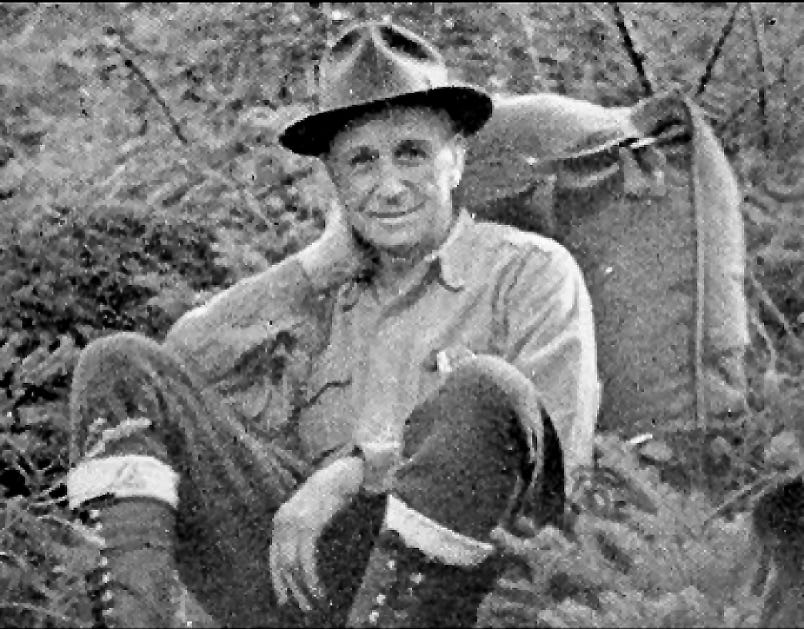
The most important event in their lives was about to occur, but it came in a skein of so many of retellings and embellishments that it is hard to untangle. Delicately phrased by a prospector in his later years: “If that’s what they say, who am I to give it lie?” Creighton himself probably uttered the words, the “they” in question being himself.
One version, recounted by George E. Cole in the 1948-9 report for the Manitoba Historical Society, goes like this: Not long after New Year’s, 1915, Creighton was tending a trapline near Fishpole Lake and hoping a moose might present itself to offer some fresh meat. Typically, prospectors spent the summer looking for riches, and in winter they trapped and hunted to pass the time, fill the larder and provide some ready cash.
On Fishpole’s shore, Creighton noticed a rock outcrop the wind had blown free of snow. The sparkling flecks in the rock attracted his attention. He stowed away what he saw. He returned to the camp on Amisk, and he informed the others. Later, in summer, the prospectors visited the site.
When one of Creighton’s crew panned dirt from a hole near the lakeshore, promising gold flecks appeared. Very promising. He showed the pan to Creighton who is reputed to have said, “Boys, this must be the place where old Flin Flon came up from the bowels of the earth and shook the gold from his whiskers!” The prospectors gave the lake a new name, Flinflon, later amended to Flin Flon.
A variation of the story I heard as a kid: Creighton fell through the ice on the lake in spring while hunting a moose. When he lit a fire to dry out, he thought he saw its flickering flames reflected in the eyes of what he took to be a fox in the bush. He threw his prospector’s pick at it. He heard it clink as it hit a rock, and when he retrieved the pick, there was the lode for which he had been looking.
Then there is the account, recorded in a 1917 report by geologist E. L. Bruce, in Memoir 105 of the Geological Survey, Canada Department of Mines: “Creighton, Mosher, Dion and their associates … were shown some pieces of sulphides by an Indian named Collins whose hunting territory lay about the north arm of Athapapuskow Lake. They recognized the possibilities of mineral such as he showed them and guided by him found and located the sulphide bodies at Flinflon Lake.”
“The Indian,” David Collins, whose mother was Cree and whose father was Euro-Canadian, was a trapper who had picked up knowledge about what prospectors were looking for. In the myth-making that attended Creighton’s part in the story, Collins was more or less forgotten, although his descendants later said the prospectors gave him $6.30 worth of flour, lard and bulk tea for his role in discovering what became one of Canada’s richest mines.
(This post is taken from Fishpole Lake, an article I published in the Spring 2025 issue of Queen’s Quarterly.)
NEXT WEEK: A town takes shape
You’re not the first person to make that conflation, and there’s a grain of truth to flimflammery, in the way the white prospectors did the Indigenous guy out of his share of the glory. More on that next week.
I had no idea that's where the name originated from. What a tale!