

Music That Never Ages
What I’m Reading


Usually the What I’m Reading feature on Life Sentences offers reviews of new or recently published books. But occasionally we will go back to books worth a second look.
The Cello Suites
J.S. Bach, Pablo Casals, and the Search for a Baroque Masterpiece
By Eric Siblin
The House of Anansi, 320 pages
Apparently classical music is enjoying a renaissance. A recent study by the Royal Philharmonic Orchestra in the UK indicates that young people are more likely to listen to classical music than their parents. Mind you, the sponsor of that study may have been looking for that result, but it’s a hopeful sign. I’m a lover of classical music myself, spending some of my children’s inheritance on tickets for concerts.
I am also re-reading a book by a Montreal journalist that succeeded spectacularly when it was published in 2009, winning several prizes. It is The Cello Suites: J.S. Bach, Pablo Casals, and the Search for a Baroque Masterpiece. When Eric Siblin wrote it, he had just left his post as a Montreal Gazette rock critic. He was staying in a Toronto hotel and out of idle curiosity attended a concert at the nearby Royal Conservatory of Music. He knew nothing about what he was hearing, but the music and the bulky instrument on which it was played were arresting.
“I hear barnstorming peasant tunes and postmodern minimalism, spiritual lamentations and heavy metal riffs, medieval jigs and spy movie soundtracks,” he writes, remembering his reaction. He spent the next nine years doing extraordinary research and writing this clever book about what he heard and how it came about.
Siblin makes J.S. Bach a real person. This Bach is a husband and father, a hustling, ambitious professional musician trying to carve out his career in an age of fawning patronage and miserable road trips. The most familiar portrait of Johann Sebastian Bach (1685-1750) shows him as an old man, and his music has has a whiff of pedantry about it, all mathematical intervals and stripped-down instrumentation. That’s the fault of 19th-century critics, who liked their music lush, dramatic and sentimental. But in the middle of the 20th century musical fashions changed and there was a revival of interest in Bach as pianist Glenn Gould recorded The Goldberg Variations and became an international celebrity.
Pablo Casals did the same. Casals (1876-1973), a musical prodigy, raised the profile of the cello as a solo instrument, paving the way for Mstislav Rostropovich and Yo-Yo Ma. He was also a deeply committed political animal. Casals was from Catalonia, a region that has always had a complex relationship with the rest of Spain. He supported the Republican cause in the Spanish Civil War, and when Franco’s fascists won, he boycotted Spain. Considered a leftist by conservatives and a royalist by left-wingers, he spoke out defiantly and lived just across the French border, as close as he could get without re-entering his homeland.
What the juries and critics especially valued about this book was the way Siblin describes the effect of the six cello suites on the listener. Music, of all the arts, is surely the most abstract. Describing a piece of music is like trying to pin down a fragrance. You have to reach for similes and metaphors, and Siblin has a mellifluous way with an adjective. He even took some cello lessons himself to get inside the music, as it were.
He courageously tackles the technical side of composition as well. For example, how did Bach, a master of polyphony in his choral music, achieve the illusion of harmony on an unaccompanied cello? On a string instrument like a cello or a violin, only one note is played at a time, apart from occasional flourishes when the bow is applied to two strings to create a chord. Siblin’s explanation is that Bach somehow suggests harmony, implies it.
I was certainly aware of the revival of this composition. A few years ago I bought a transcription of the score for the violin, and practised much of it. I even took the score to a summer concert by Brian Manker, the chief cellist of the Orchestre Symphonique de Montréal.
Manker, perhaps unwisely, played all six suites in one concert. He had to change his shirt at intermission because it was soaked in perspiration. Following my violin score as he played was an odd experience, because I could tell when he was making a
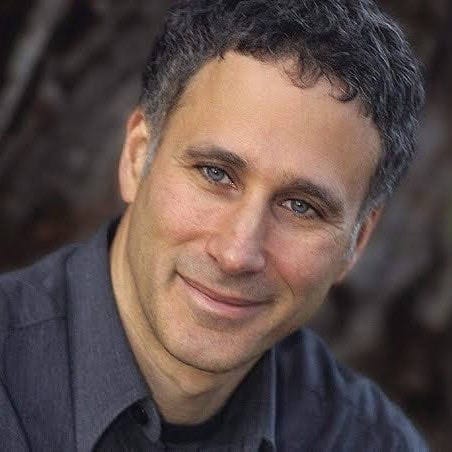
mistake, and he made a lot of them, but I admired his nerve. Now I admire it even more, after reading what Casals went through to re-introduce this work to the world—really, to present it for the first time as a masterpiece, because it wasn’t appreciated in the 18th century. It was ahead of its time.
Eric Siblin has written a novel, and I’m waiting for a local bookshop to tell me it’s ready to be picked up. It’s called The Fatal Scroll: A Herculaneum Mystery, published last year. I have been to Herculaneum, the lesser-known, better-endowed cousin of that earthquake-devastated city, Pompeii, and I can’t wait to see what master researcher Siblin has done with it.
 | A guest post by
|
A wonderful interview, David. Thank you so much for sharing.
Excellent piece, Barbara. I, too, have been to Herculaneum, and The Fatal Scroll is high on my to-read list. Eric's a talented guy and I'm eager to see what he did with this.