

Not so Innocent Abroad
What I’m Reading

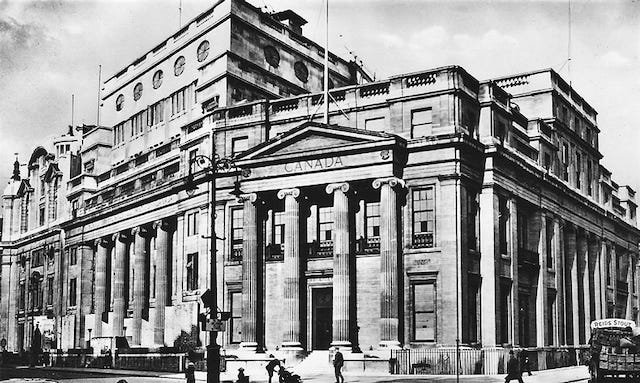
September 1941. Bombs are no longer falling on London as the Luftwaffe turns its attention eastward. Amid the rubble and the threat of invasion, people have warily begun to put their lives back together. They go to pubs, concerts and the cinema, making do with shortages and curfews. And, as in any big city, there is its underside, the usual skulduggery that never goes away.
Such is the scene that John Delacourt offers in The Innocent Canadian, a suspense novel set in a beleaguered London. The focal point is Canada House on Trafalgar Square, then and still this country’s diplomatic presence in the British capital.
The innocent Canadian of the title is William Davenant, a junior diplomat – mainly a speechwriter – whose bosses are Mike (Lester) Pearson and the head of mission, Vincent Massey. Davenant might be naïve in a quaintly Canadian way, but he’s no fool (though sometimes taken for one), and he’s soon deep into a complicated intrigue involving German or maybe Russian spies, fascist Brit nobility and disreputable Americans trying to keep their country out of the war. Along the way, Davenant falls in love with an Irish-born writer named Colette Cluny. She and an American ballet dancer Davenant had taken up with earlier add some erotic fizz to the proceedings, in a demure Canadian way.
One of the pleasures of the novel is seeing historical figures, some Canadians, in well-wrought fictional guise. Along with Pearson and Massey, the Davenant and Cluny characters are based on real people, loosely impersonating the Nova Scotia-born diplomat Charles Ritchie, and the Anglo-Irish writer Elizabeth Bowen. Ritchie’s diaries and Victoria Glendinning’s Love’s Civil War: Elizabeth Bowen and Charles Ritchie provided Delacourt useful source material.
He also brings his own experience to bear. Delacourt lives in Ottawa where he has spent many years in the federal bureaucracy or in work adjacent to it. “The day job informs a lot of my understanding of the complex dynamics, the choreography of power,” he said when we spoke by phone this week.
“I’m fascinated by the way Ottawa works, by how transactional decision-making occurs. So much of it is freighted with really important decision-making and you realize, people come to these decisions with all the frailties, all the vanities.”
This understanding is transposed to wartime London. A scene in the novel illustrates. Vincent Massey, for whom creature comforts and a tipple were not unknown, gives Davenant a dressing down for hanging out with “bohemians” in the city’s demimonde where he’s been drawn in pursuit of a murderer. Massey’s concern is to uphold the propriety of Canada House, but he recognizes in his protégé his talent and a bit of himself. The exchange between the two men is pointed, but it has the subtlety of lived experience.
“How to dramatize that, make it vivid and evocative, how to make a plot work from that – those were the challenges,” Delacourt said he faced.
Which leads to another observation. This is a well-crafted novel, constructed from details wittingly assembled. In one scene Davenant notes the satchel carried by a spy he is interviewing in a bombed-out church: “The satchel looked like it had seen better days. Probably weathered from field trips abroad … fond memories no doubt. The vanished Europe, his cathedral of nostalgia.”
This speaks to an audience that knows some history and can appreciate its nuances. The Innocent Canadian reminds me of a Kate Atkinson novel, not quite there, but on the same playing field.
Given his experience in government, I had to ask Delacourt whether he has something planned that is set in Ottawa. He does. He’s just completed a novel involving a murder in Rockcliffe. That should set tongues there wagging.
The Innocent Canadian
By John Delacourt
Now or Never Publishing, 300 pp

Delighted to see you -- though I don't think we ever met in person. But thanks to your review of Alice Goldbloom's book, I find you again.. .still with books. I will order this one from my Indie bookstore.