

Open, Oyster
What I’m Reading

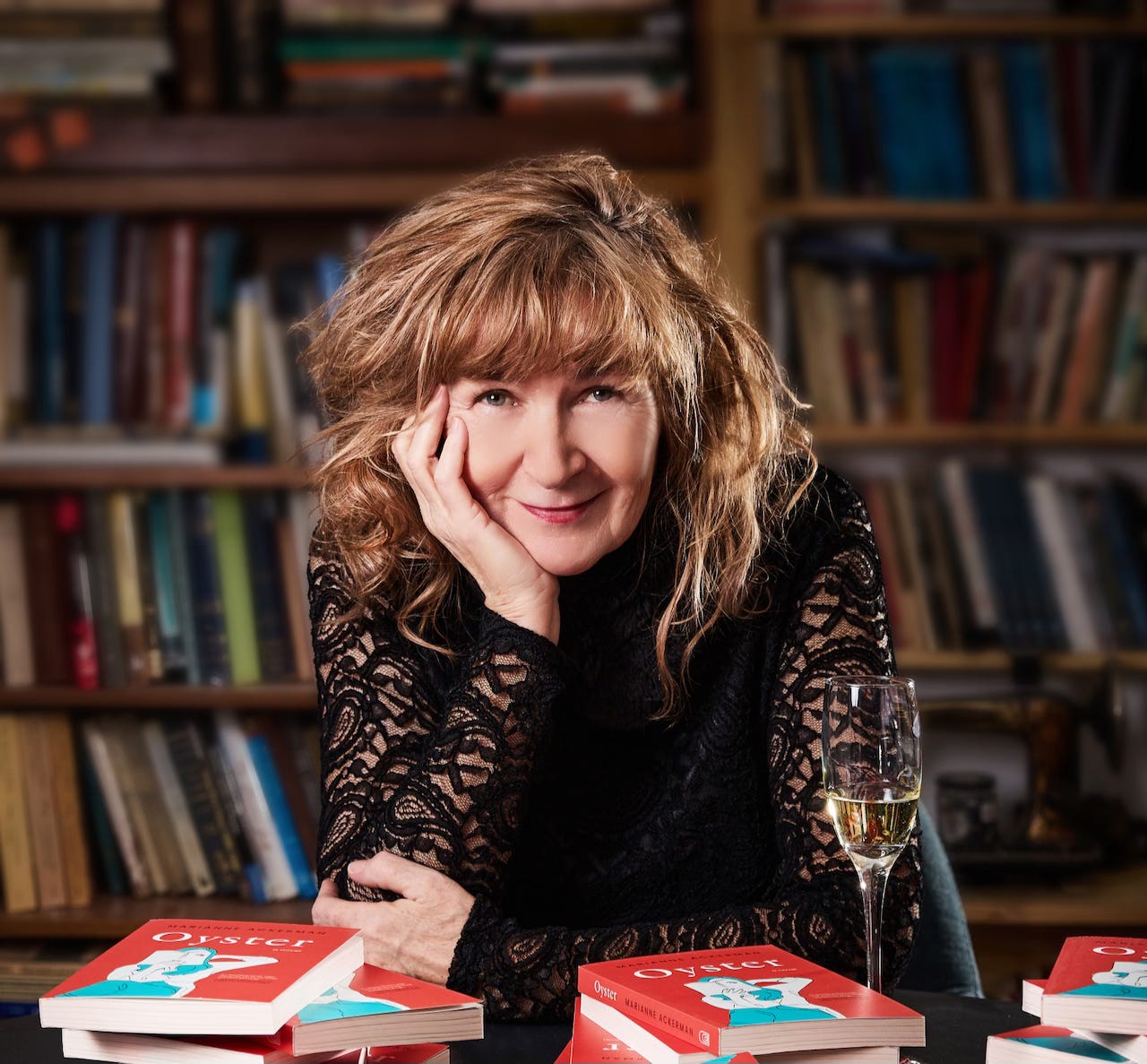
Hats off to Marianne Ackerman for coming up with one of the cleverest titles for a novel I’ve seen in a while. A single word, Oyster, opens up layers of meaning, all relating to the story she tells.
“The world is your oyster,” is a well-worn expression that suggests that opportunity abounds, especially for the young. It is also a title suggested for a novel that Amelia Cameron, a once successful writer aging into obscurity, accidentally bequeaths her niece. Amelia’s rewrite of the ingenue’s first fiction pushes the novel all the way to a Giller nomination. The send-up of the Toronto-centric literary navel of Canada, hungry for fresh talent, is wicked.
But there is another metaphorical oyster at the heart of the story, one that originates with Shakespeare (who else?). It has quite a different meaning, which Ackerman, as much playwright as novelist, knows. “The world’s mine oyster, which I with sword will open,” says a character in The Merry Wives of Windsor. The forcing of fate with its concomitant rewards references a romance in the novel and a struggle for reconciliation in an unhappy family (aren’t all the interesting ones?).
The Camerons of Prince Edward County, four siblings with a tenuous hold on solidarity, are thrown into disarray by the death of the family patriarch, Amelia’s father. Ackerman knows the territory well having grown up in the County, as the locals call it, and her depiction of middle-class strivers in rural Ontario has the ring of insider information. The sorting out that follows leads to a revelation: grownup children must leave their childhoods and sibling rivalries behind.
Amelia and her literary agent, Barry, provide the romantic spark. Theirs seem unlikely grounds for a relationship. He is aware that her best-before date as a writer has probably passed, but he keeps her hanging on. Out of kindness or cowardice? Maybe both. Amelia sees through Barry in all his particulars, finds him inadequate to her needs, but he is difficult to let go, as agent, friend and occasional lover. How will it all work out? Only the denouement will tell.
That’s a lot of freight for a slender novel, but Ackerman carries it off, in part, she told me, because she’s had plenty of time to refine her story. We spoke recently at her kitchen table in Montreal’s Mile End district, where I detected another oyster analogy in her career. It comes from the grit that accumulates in an oyster’s shell that over time produces a pearl. This novel, her fourth, has been a few years in gestation, something she says was good for the book.
“It has the most distilled residue of theme,” she said. “It goes to show sometimes not to be published (right away) gives a book time to marinate.”
It helped, too, to have a good editor. No agent for Ackerman with this book. She sold it “over the transom” to Dundurn Press, a smallish but respected house and one not yet bought up by a global conglomerate as much of Canadian publishing has been. Dundurn assigned her an editor (Robyn So) who lives on Salt Spring Island, someone about as far away from Prince Edward County and its concerns as one could get.
“When the editor emailed a number of questions and comments, I had to lie down. ‘She doesn’t get my book.’ But when I calmed down and worked through it, it was way better. She had that energy that you need for the last lap of the marathon. It got me re-engaged. I think the novel is way better for her editing.”
Engagement has never been in short supply in Ackerman’s artistic striving. She co-founded and helped run the company Theatre 1774, an ambitious attempt at reconciling French and English across a longstanding cultural divide. She wrote and saw staged a clutch of other plays. She ran an arts website called Rover, perhaps ahead of its time in its focus in bringing news and views to an online platform. And, in between, there were the novels.
Throughout, Montreal has been the city in which she has made her stand, despite what she sees as the fading place of Anglos in Quebec’s cultural firmament.
“There’s no sign of a pulse… there’s activity but no leadership … you cannot get a posse together,” she said.
Restless and ever on the move, she would like to move beyond rabblerouser to perhaps being that leader in the city’s arts community. But not at any cost. When I suggested that she reminded me of an old-time labor organizer, she responded:
“The most important thing is to put to the work first. Be sure you’re writing your own voice. But if the opportunity came along to step up with a banner, I would. But I can’t manufacture the moment. I can only wait.”
Oyster
By Marianne Ackerman
Dundurn Press, 244 pages
Congrats to Marianne on her new book. Happy to learn of Oyster. I thought it was good to mention the editor and how valuable her work was. That rarely if ever happens in a book review.
Kindle edition ordered!! Thanks for a delightful review of a book and the writer.