

Summertime Blues


Summertime and the living is … well, not exactly easy. The weather has been good where I’ve spent the past few weeks—Quebec and eastern Ontario—but a pall settles over my sense of well-being. Maybe it’s the smoke hanging over half the continent, reminding us that Nature does not take kindly to being plundered.
There’s a lot more going on in the world, much of it worth fretting over, but if your personal life hasn’t been upended, there’s cause for thanks.
But the constant static remains. It makes me think of other times and places, good and bad. This is the product of living a long time, enough to have wisps of the past come back unbidden. An example: Hermann Gruenwald showed up the other day.
Hermann died in 2020 after a life well rewarded. He was a Holocaust survivor, so it might be said that everything was gravy after that experience.
I got to know Hermann well because I wrote an as-told-to memoir about his life. In After Auschwitz: One Man’s Story, he recorded the good and the bad of his days, and there was plenty of both. Among the good, raising a family and crafting a successful life in business. He loved his chrome green Jaguar, a car he could take for granted, although he never forgot the number on his arm: A-12483. Among the bad: being given the number when he was dumped in Auschwitz, age 19, and learned of his parents’ deaths there. But the concentration camp was only the beginning of the evil that befell Hermann.
Auschwitz was evacuated in January 1945 as the Soviet army approached. Thousands of prisoners were marched westward over a frozen landscape, Hermann among them. Some 15,000 from the camp died on the road. As men weakened, they fell back to the end of the column. When they couldn’t keep up, a guard might ask, “So you don’t want to march any more? Okay, lie down.” A double tap was applied, two shots, to ensure a quick death. It was the Nazi version of a mercy killing.
Eventually, Hermann reached his column’s destination: Mauthausen, another camp which at that late stage of the war would prove worse than Auschwitz. It was a scene there at the outset that has stuck with me. Groups of men stripped and were herded into a shower room. As Hermann stared up at a shower head, he wondered, what would it be: gas or water?
By then prisoners were aware poison gas was used to kill them, if not exactly how it was applied. No one came back to explain. Until that moment, they had had a smattering of agency. Even on a death march, the will to live might keep a person alive for one more day. In that moment, naked, staring up at the shower heads, there was nothing left, only fate.
Water poured out and life went on.
In most cases, no matter how dire the circumstance—a diagnosis of a fatal illness, the loss of a loved one, the rumblings of war and destruction approaching ever closer—there is usually a way forward if only to gain inches or days. But as I look up into the sky this summer, I wonder if our ability to change what is happening and the time to do so are running out.
What will it be? Gas or water?
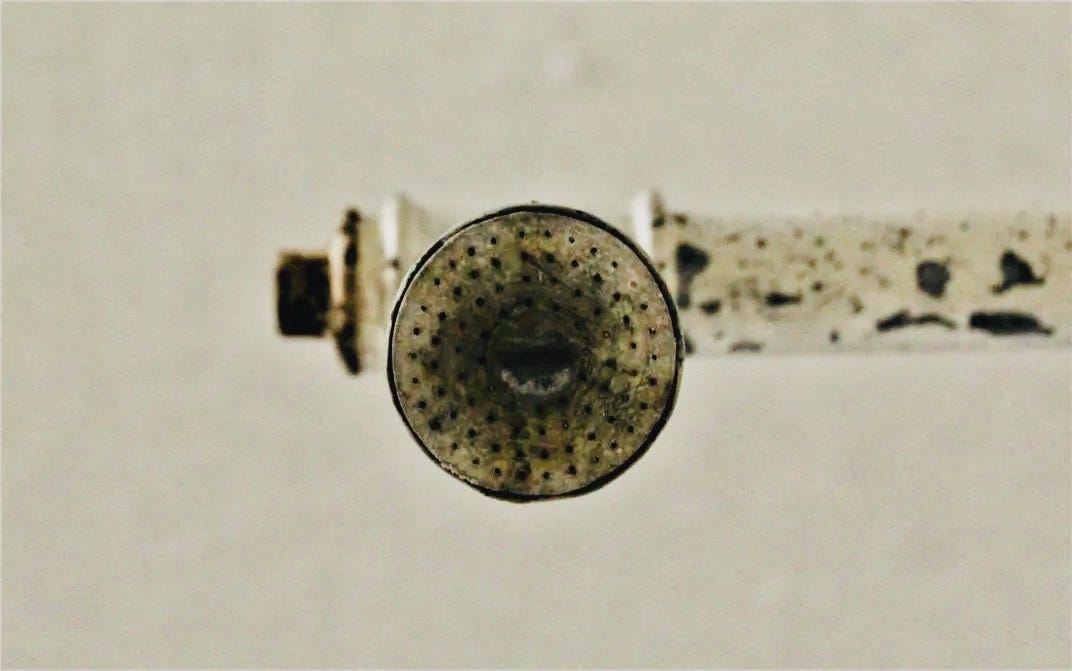
"Gas or water"...the gods are laughing as they sprinkle "hope" as stardust and taunt us...
Hi Bryan
Have a wee story..
Was helping a friend deliver a load of hay to an old barn. It was for an elderly Ukrainian couple... only knew them as big Joe and his wife... his wife worked the garden and she had to crawl up and down the rows but never stopped. She sold the vegetables in the Brentford market... always had the best sourkraut...one morning as she was filling my container I saw the tattoo number on her arm...I cried...