

The Problem Solver

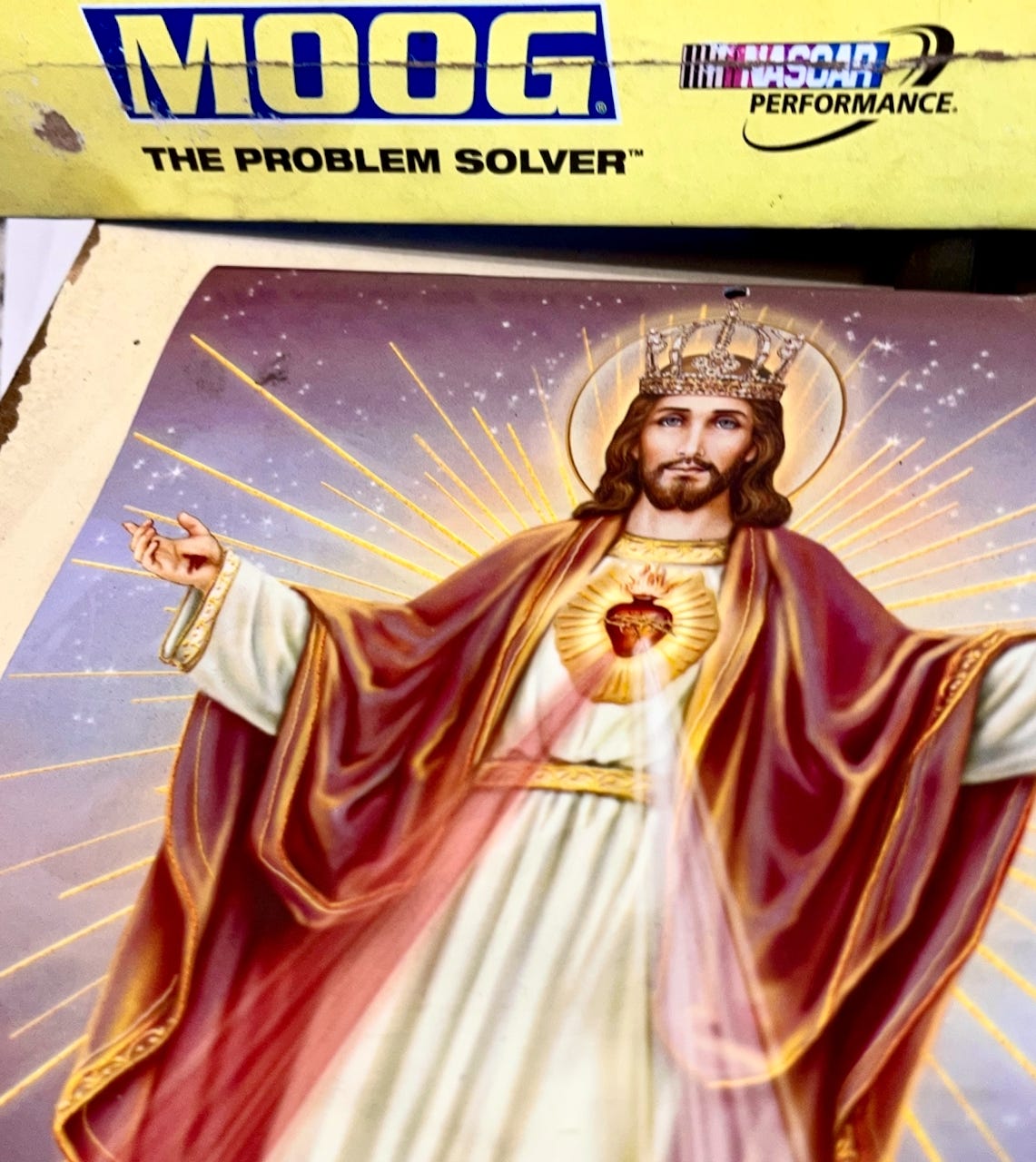
One day in spring 2022, I was at the garage where my wife and I get our car serviced. We were changing our winter tires for summer ones. An oil change was part of the seasonal ritual.
It was sunny afternoon with a promise of the summer to come, and lively music filled the garage manager’s cluttered office. I waited for him to retrieve our car keys. On the desk lay a poster of an eastern-looking Jesus with an auto-parts box next to it. “MOOG THE PROBLEM SOLVER,” it said.
“Russian?” I asked the manager, whose name was Alex, about the music when he returned. “Yes,” he said, and we briefly discussed how a satellite transmission brought it into the office from somewhere in Russia.
We bantered a bit during my visits. He must have deduced from my name my heritage was probably Polish or Ukrainian, but this was not a subject we entered into. It was enough that we trusted each other and could conduct the business at hand.
Still, I felt a certain unease. Weeks earlier there had been a massacre in Bucha, Ukraine. At about that time I had begun to hate Russia, and Russians, too. Russian soldiers had gunned down men and women in the streets. Civilians were summarily executed in basements. What was wrong with these people, I wondered, who seemed, generation after generation, so unable to pull themselves from the primeval sludge, who would follow a cruel despot they cynically knew in their hearts to be damaged goods? Maybe it was because they were too.
My animus came from a particular place. My family was from Ukraine before it was called Ukraine. The part they lived in at the turn of the 20th century was a province of the Austro-Hungarian Empire. Being under the political domination of a stronger power was something Ukrainians knew well. It made them guard their faith, their culture and language, and the people who immigrated to Canada brought these with them. Three generations later in my family there are only shards left of who we were, but they shine bright with remembrance.
I’ve been to Ukraine three times over the years, first in 1989, when it was just beginning to pull itself out from under the dead hand of Soviet communism. A revival of religion was an early sign of a breaking away from Russia. In 2001, Kyiv was bustling with entrepreneurial energy. So many people out to make a buck. It felt like an outburst of hope.
In 2019, with the loss of Crimea, the atmosphere was more subdued. The reality had set in that Ukraine was a poor country rife with corruption, living next to an unfriendly giant next door. In counterpoint, everywhere there were flags and tributes to those who died in the Maidan massacre of 2014. The uprising in Kyiv’s main square was a final turning away from the Russian past. It signaled that Ukrainians, despite their problems, were free at last and could turn to the West for help with those problems.
During those visits I felt a kinship with people I met, especially those in the countryside, who were so much like the people I grew up with.
This background sets up where what I felt for the invaders came from. Most people express anger at what Russia is doing in Ukraine (and for what other countries are doing elsewhere to their neighbours or even their own people). But for me, the feeling was more visceral. It was the call of blood to blood, a revulsion bred in the bone.
A recently published book reminded me why such kneejerk hatred is an unworthy. Anglo-Dutch writer Ian Buruma in Stay Alive: Berlin, 1939-45, describes the deaths and displacement of half the population of German capital during the final battle for that city. There is satisfaction in seeing retribution levied on the heart of an abhorrent regime and on people who perpetrated so many crimes against humanity.
But while Buruma gives full accounting of this payback – justice it might be called – he writes in some detail about how the innocent suffered with the guilty: people who despised the Nazis and worked against them, who hid Jews in their homes at great risk, indeed the few thousand Jews who were still in the city – all were swept up in the maelstrom. Surely the same is true in dozens of places where bombs are falling today, in Tehran, the Middle East and elsewhere. They fall upon the guilty and innocent alike, breeding new cycles of hate so that new atrocities will occur, and more bombs will fall.
Back to Alex at the garage. I don’t know his version of the Ukraine war, and he doesn’t know mine. I do know that he is a good guy, friendly, honest and reliable. I try to keep that mind, and I am grateful to live in a place we can do business together.
There are some problems Moog cannot solve. But to remember the humanity of others is a way to preserve your own.
Lots of wisdom in your last sentence.
Whenever I meet someone from the opposing side, that I might justifiably hate, I try to imagine then as a small child. It's more difficult to hate a child, and it reminds me that we are not born monsters - we are forged into darkness by suffering and pain.